
Pranayama Breathing Practice
This is a breathing practice we offer to guests at our retreat, drawing on both ancient yogic tradition and contemporary research.
Background
Patanjali’s Yoga Sutras, written approximately 2,500 years ago, describe a method of Pranayama in which the practitioner simply maintains attention on the breath — observing where it is felt in the body and its timing. No manipulation of the breath is required. This sustained attention is presented as a means of steadying the mind and accessing quieter states of consciousness.
Contemporary research into breathing mechanics, documented in James Nestor’s Breath (2020), identifies 5.5 seconds as the optimal duration for both the inhale and exhale — approximately 5.5 breaths per minute. This pace has been associated with improved cardiovascular function, reduced stress response, and greater nervous system coherence. This practice combines that rhythm with Patanjali’s attentional method.
Binaural Beat
The recording includes a binaural beat in the theta frequency range (4–8 Hz), audible only through headphones. This is produced by playing two slightly different tones — one in each ear — which the brain registers as a low-frequency pulse. Theta frequencies correspond to states of deep relaxation and meditation. It is a supplementary element; the practice is complete without it.
Instructions
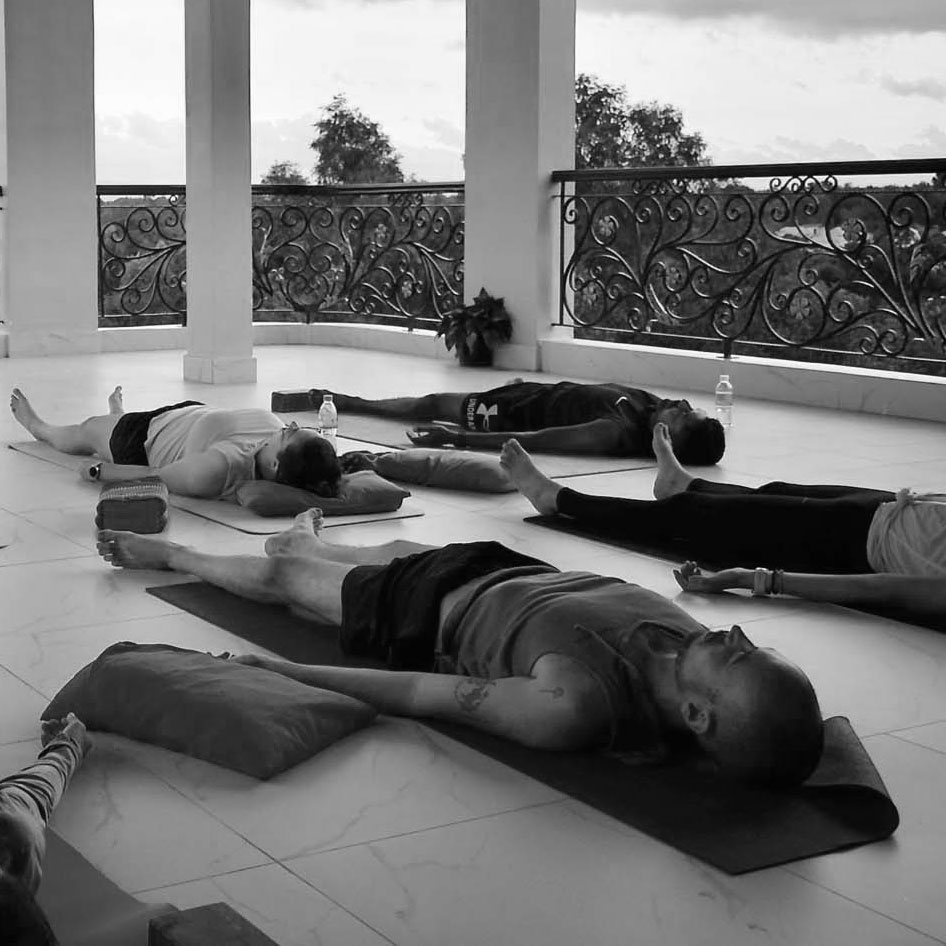
- Lie down in a comfortable position. Place one hand on the chest, one on the abdomen.
- Use headphones where possible.
- Inhale on the first tone; exhale on the second. Each lasts 5.5 seconds.
- Aim to fully empty and fill the lungs in time with the tones.
- Keep attention on the physical sensations of breathing — movement, temperature, the rise and fall of the body.
- When the mind wanders, return attention to the breath without judgement. This is a normal and expected part of the practice