
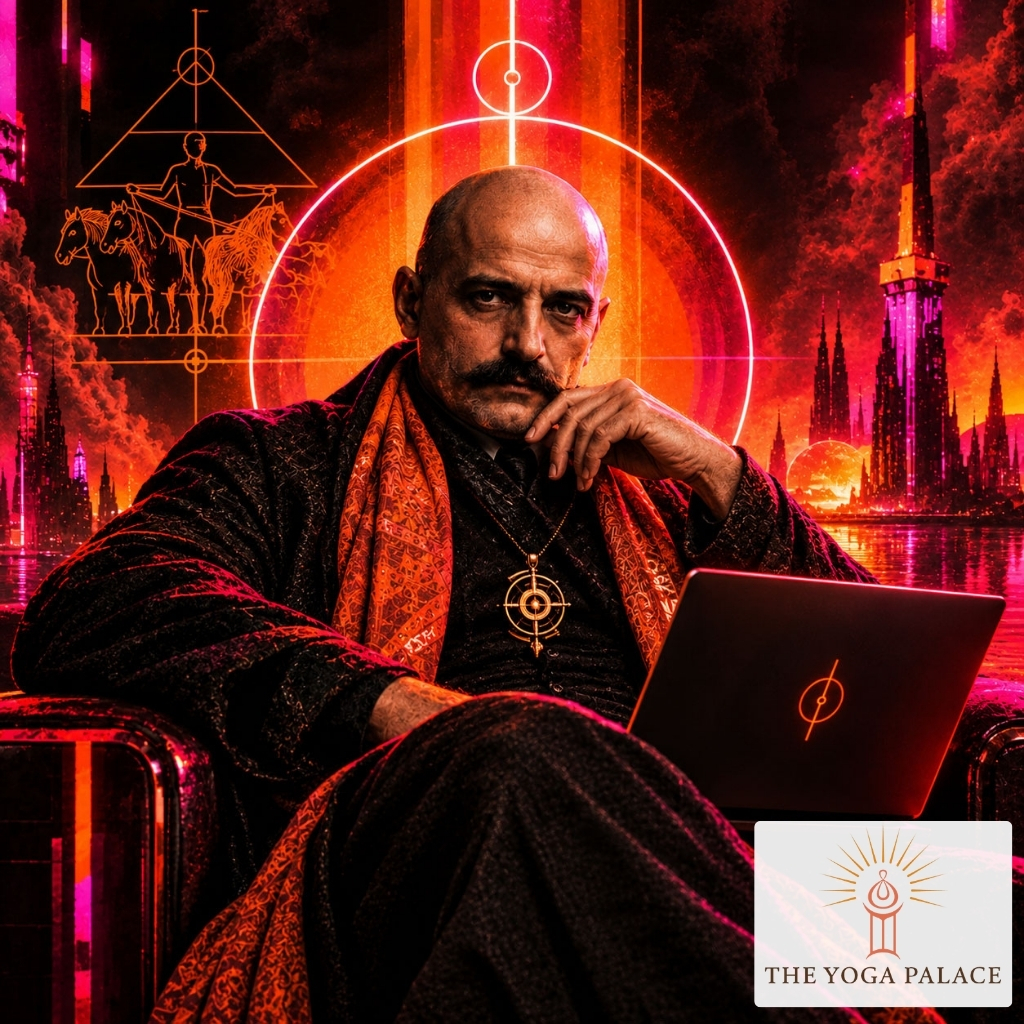
“In order to awaken, first of all one must realize that one is in a state of sleep. And in order to realize that one is indeed in a state of sleep, one must recognize and fully understand the nature of the forces which operate to keep one in the state of sleep, or hypnosis…”
— G. I. Gurdjieff
The AI Revolution
We are in the midst of the AI revolution. Suddenly, we can talk to our computers just like we talk to each other. Instead of writing this article myself, I could simply ask Claude or ChatGPT. I can outsource my thinking, creativity and writing ability – saving myself a lot of time but probably losing a few brain cells in the process (recent studies have shown that using AI is literally damaging our brains).
The chat bots seem extremely intelligent and are certainly capable of incredible things. But anybody who understands the technology knows that all they are doing is a bunch of maths to calculate the most statistically appropriate response to whatever you ask. What seems like advanced intelligence is really a clever mathematical trick. It takes an input, crunches a bunch of numbers, and figures out the most probable output. The reason it seems so smart is that it has been trained on a staggeringly large amount of information (practically all the written language and computer code in existence).
Are We So Different from Machines?
While our new thinking machines may not possess genuine intelligence, they are already being used as substitute friends, therapists, and some poor lonely souls are even falling in love with their chat bots. It all seems rather dystopian, but perhaps our newfound love of these machines can teach us something about ourselves. That, in our default state, we are not so different from machines ourselves – we simply react to our environment, thoughts, and emotions – reacting like a pre-programmed system without free will.
Gurdjieff: Humans Are Asleep
The key insight of the 20th-century philosopher and mystic, G. I. Gurdjieff, was that we human beings are asleep. We think we are freely making decisions, but in reality, we are more like machines. The input is our surroundings, thoughts, feelings, emotions, memories and so on; the output is our next “decision”. Even our beliefs and opinions about ourselves and the world are simply responses to the input we receive. Think of somebody who reads the news all day, then expresses opinions about political events – all they are really doing is regurgitating information, just like a chat bot.
In the wake of this strange technological revolution, many philosophers and spiritual teachers have pointed out that it is impossible for AI to possess consciousness – since it is simply a bunch of calculations. This raises concerns about the fact we are treating these things like they are conscious. But if Gurdjieff is right, the problem isn’t so much that the machines are unconscious – but that we are.
If you really pay attention to your mind, you may see the somewhat concerning possibility that you are mostly asleep. 90% of our thoughts are recycled from the previous day; our minds tend to follow the path of least resistance, following the same habitual patterns we have built up over our lives, staying in a kind of familiar comfort zone (even if the comfort zone is not so comfortable). Even if you have tried to introduce new habits, or change the way you think, you may have noticed the tendency to slip back into the sleeping state of following that same old programming.
The Possibility of Awakening
The good news, according to Gurdjieff (and backed up by thousands of years of Eastern and Western esoteric thought), is that we DO have the possibility to awaken. We can become more than machines; we can develop that mysterious power sometimes known as “free will” and start to take control of our lives.
The Chariot, the Rider and the Horses
The first step to becoming free and leaving behind the mechanical life is to become aware of your sleeping state. One of the ways Gurdjieff helped people to see this was by presenting a metaphor that divides a human being into three different aspects: the body (represented by a chariot), the mind (the rider), and the emotions (the horses). He said that in our default, sleeping state, these three aspects often neglect to communicate with each other – and often even work against each other. There is plenty of overlap between the mind, emotions, and body – but imagining them as separate entities can help us to see the disharmony present in the default human condition.

The Body
Your body is right now engaged in billions of processes that are almost unimaginably complex. Your cells are replicating, your blood is being pumped around your body, oxygenated and cleaned of impurities, and your immune system is fighting a perpetual battle against pathogens. As you read these words, billions of neurons fire with electrical and chemical signals in your brain. The body is incredible, even a single cell possessing more complexity than anything humans have created, yet somehow, we are unable to cooperate with the process. Often, we neglect or harm our bodies. The last thing the body of an alcoholic needs is more alcohol – yet it cannot stop the person pouring more poison down their throat. This may be an extreme example, but who can say they give their body exactly what it needs? In the modern world, there is rampant obesity, poor posture and fitness, and endless problems caused by us refusing to cooperate with nature.
The Mind
The human mind is beautifully creative, and able to achieve absolutely incredible things: every great scientific advancement or work of creative genius came from a human mind that was able to focus and work to its fullest potential. But the mind can also be our worst enemy. By closely paying attention to thoughts, you can start to notice how they follow a familiar track. In the same way that a chat bot generates text from a user input – based on everything that it has learnt – your mind generates thoughts from the thoughts that have come before. Most of our thoughts are simply recycled from the previous day, forming a chain that goes back an entire lifetime (and Eastern mystics would say this extends into previous lives, as the Buddha realized during his awakening process). The mind also has a tendency to overthink, to get the wrong end of the stick, or just go around in circles – Hindu mystics have compared it to a drunken monkey that has been stung by a scorpion!
The Emotions
If you become aware of your emotions, you will notice that they often completely dictate your actions. Feelings of anger, sadness, strong desire and so on take complete control of your mind and body – as if you are a chariot rider being pulled along by wild horses. The emotions can motivate you towards positive actions, or they can compel you towards negative ones; they can even make you freeze and prevent you from doing what you know you need to do (this is obvious to anybody who has struggled with depression or anxiety).
With a lot of self-examination, you may come to see that – like wild horses – your emotions are pulling you around haphazardly, the mind is constantly overthinking, getting the wrong end of the stick, and following familiar thought patterns even when they are not helpful. The poor body is getting dragged along for the ride, its needs often ignored.
Am I Awake?
By writing this article, I am certainly not trying to claim I am awake. The reason I started it was because I was feeling guilty about having neglected the blog. I had been thinking about Gurdjieff because one of the guests at our Yoga retreat in Cambodia mentioned him. So did I decide to write this article? Or was I simply pulled along by my mind and emotions, which then compelled my body to start typing away?
The Fourth Figure: The Will
Still, you should not be disheartened if you notice this disconnect and lack of free will. If you look at the image again, you will see a mysterious fourth figure who connects the chariot, rider and horses. This is the Will, your real self. It is similar to the Hindu concept of the higher self, the one that Patanjali’s Yoga Sutras point out is your true identity, which you can rediscover with the right attitudes and practices. Over two thousand years earlier, in the Bhagavad Gita, the warrior Arjuna is aboard a chariot driven by Krishna – God incarnated in human form. Arjuna has put Krishna in charge of his chariot, which means he is no longer driven by personal desire, but is following the divine purpose. It is likely Gurdjieff borrowed from this metaphor with his own horse and chariot concept – the symbolism is the same: we are to be led by something higher if we are to go in the right direction.
It should be noted that at this point Gurdjieff departs from Western psychology. The Will is not part of the mind; it’s something non-physical, seemingly invisible yet all-powerful. It gets rather difficult to talk about without sounding too esoteric, but here is a quote from one of Gurdjieff’s disciples, Jeanne de Salzmann, who wrote extensively about his teachings:
“I now understand that conscious sensation is the first sign of obedience to something greater, the first step toward a true feeling. Here I glimpse the possibility of a direct perception. My tyrannical ‘I’ submits and no longer dominates, no longer trying to show its strength. I feel another force, not a power that I possess but one in which I am. At this moment there appears an energy coming from a higher emotional current, irresistible so long as it is obeyed. It is this energy, a cosmic force passing in us, that all traditions call ‘love.’”
— Jeanne de Salzmann
Ceasing to Be a Machine
To wake up to the reality of this force is to cease to be a machine. When the Will is in charge, the body, mind, and emotions work together for a common purpose. The emotions provide motivation, the mind makes clear decisions, and the body carries out the appropriate action.
“As I become empty of all pretense of knowing, my feeling becomes more stable and purified, able to weigh opposites, that is, able to know. When the action of being is felt as a necessity and as something I truly wish, I become capable of communicating this feeling to all my centers so that they are integrated into a single whole.’”
— Jeanne de Salzmann
When the Will is in charge, all of these parts are aligned with a higher power which expresses itself through you – or rather, it IS you, and you are IT. This is something hard to explain but possible to experience.
Surrendering to a higher power may sound like the death of freedom, but not when you notice what it is you are surrendering. You are surrendering the tyranny of being at the mercy of the mechanical process of the body, mind, and emotions. If emotions don’t seem mechanical to you, just think about the way they seem to be able to switch themselves on and off regardless of whether you want them or not.
When the Will is in charge, you are going with the flow, expressing yourself in harmony with something greater than yourself. You are no longer like a chat bot, following pre-recorded rules to match inputs with outputs; you can create things that are truly new, that come from the source of creation itself.
The first step is just to notice that you are asleep.